


A cantilever chair is a comfortable designer chair with a supporting frame and metal skids. The most striking features are the missing back legs and only 2 legs in the shape of skids at the front. Due to the chair's construction, the seat swings slightly when you sit on it and move in the chair. The chair's movements make the cantilever chair comfortable and back-friendly even during prolonged sitting – the intervertebral discs, spine, and back muscles remain active due to the slight movement of the seat and backrest, allowing for ergonomic and relaxed sitting.
Cantilever chairs were introduced by Ludwig Mies van der Rohe in 1927 as swinging chairs and further developed by Marcel Breuer regarding the elasticity of the supporting tubular steel.
The development of the swinging chair can be seen as a further development of the chair without back legs designed by Mart Stam in 1926 under the name Kragstuhl. However, this Kragstuhl has a rigid tube construction and hardly swings.
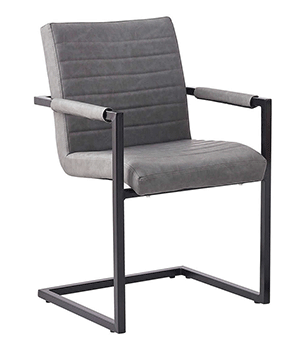
The advantages of a cantilever chair concern both seating comfort and stability. The chair is comfortable, convenient, and healthy even during prolonged sitting. Due to the metal frame, floor skids, and front legs, it is stable, tip-resistant, and quite robust even with higher weights.
Depending on the design, cantilever chairs are available with or without armrests. The armchair version is more comfortable due to the arm support and is the typical chair for the living room. The cantilever chair without armrests is often used as a dining chair, a chair at a conference table, or in a waiting area. Due to the lack of armrests, it can be easily pushed under the table.
Despite its age, the cantilever chair still looks elegant today due to its special design. It fits well with modern interior styles, but also perfectly as a deliberate contrast to rustic tables such as a live edge dining table.
What materials are cantilever chairs made of?
The frame of almost all cantilever chairs is made of metal, as this ensures permanent flexibility and "bouncing ability". There are models with an elastic, hollow steel tube or with a stainless steel frame. Some variants have a frame and skids made of laminated veneer lumber panels, as this also allows for the production of flexible and robust furniture parts with a curved shape.
The upholstery of the seat and backrest is made of textiles, artificial leather, genuine leather, rattan, or mesh fabric.
Where can the swinging chair be used?
In the dining room, the cantilever chair is perfect; you sit upright while eating and can lean back comfortably when not eating. Models without armrests are ideal here, as they can be easily pushed under the table without colliding with the underside of the tabletop.
In the living room and conservatory, a swinging chair with armrests serves as a relax chair and an alternative to the classic rocking chair – here you can comfortably read a newspaper or a book or watch TV from an elevated position. For people who struggle with a low sofa, a cantilever chair is also a good alternative.
In conference rooms, waiting rooms, and visitor areas, cantilever chairs are very popular. They signal a sense of design and modernity and allow for comfortable and relaxed sitting even during longer conferences, events, or waiting times.
Further information about swinging chairs, their development, and construction can be found on Wikipedia


